Category: Christianity

Then what?

Benjamin Franklin is generally credited with saying: ‘In this world nothing is certain except death and taxes’. While it might be just about possible to avoid paying taxes it is absolutely certain that sooner or later every one of us will die.

So then what?

Well whether our bodies are cremated, interred or buried at sea it is beyond doubt that our physical bodies do end up as ‘dust to dust, ashes to ashes’ as the words used in most funeral service declare. But is that it, is that the end of us?

Well the vast majority of faiths would affirm that that is not the case, that there are two elements to all human life. These are usually referred to as the body, the physical element, and the soul, the spiritual and invisible element. During life these two elements are inextricably bound together but when we die they separate. We know what happens to the body but what about the soul?

The most reliable source of information regarding this is The Bible, although the Qur’an (the Muslim scriptures) does refer to life after death and has some similarities.

The Old Testament has very few references to life after death. The prevailing concept is of eternal rest (in a place called Sheol) but there is little expansion on this. So we need to turn to the New Testament.

In the time of Jesus there were varying traditions and beliefs within Judaism. One group, called Sadducees, did not believe in any form of life beyond death but that one’s situation in life was dependent on how well the individual followed the laws set down by Moses. So the good prospered and the bad suffered.

Jesus did not subscribe to this view, so some Sadducees challenged him with a hypothetical situation; A man married a woman but he died without his wife having any children so his brother married her (in the Jewish tradition of the time, if a married man died without children his brother was obligated to marry his widow and have children to preserve the family name). In this story the brother also died without children and so the next brother married the widow and so on several times. Finally the woman died. The question they posed Jesus was:’ So whose wife was the woman when they all got the heaven? ‘

Jesus replied, “You are in error because you do not know the Scriptures or the power of God. At the resurrection people will neither marry nor be given in marriage; they will be like the angels in heaven. But about the resurrection of the dead—have you not read what God said to you, ‘I am the God of Abraham, the God of Isaac, and the God of Jacob’? He is not the God of the dead but of the living.”

So here we have an unambiguous statement from Jesus that there is most certainly life after death.

When Jesus was crucified he was not on his own, there were two criminals crucified with him. One of them asked Jesus to remember him when he entered his Kingdom. To this Jesus replied: “Truly I tell you, today you will be with me in paradise.”  It seems inconceivable that Jesus, so close the death himself. would have promised something that he couldn’t deliver.

At the Last Supper Jesus told his disciples that he was going to ‘prepare a place for them’. In the context of his imminent crucifixion, this could only mean a spiritual place.

So if there is indeed life after death what is it like and does everyone end up in the same place?

What heaven is like is a difficult one. We live in a finite world where time passes, so it is virtually impossible to comprehend any environment where time doesn’t exist – eternity.  What would we do in eternity? These are unanswerable questions. There are lots of analogies in the Bible but these can only give an inkling. What we are assured is that in Heaven we are close to God and all the pains, cares and concern of this life will no longer exist, we will be in a place of perfection and harmony.

Does everyone end up in Heaven? – The short answer is, no.

Probably the most famous verse in the Bible makes this clear: ‘For God so loved the world that he gave his one and only Son, that whoever believes in him shall not perish but have eternal life.’

So what happens to all the rest?

Before we get to that let’s look at ‘whoever believes in him’

This doesn’t mean an abstract belief in Jesus as an historical figure, a good man, or even that he was someone sent by God. It means a belief in Jesus as the Son of God, an acceptance of his teachings and a commitment to do our best to follow them.

As James says in his letter; ‘faith by itself, if it is not accompanied by action, is dead’.

As to what happens to everyone else.

Much as this is probably the answer that we don’t want to hear, the inescapable truth is that after our physical death each of us will be judged. The good news is that God alone is our judge – we do not get to judge one another. As a graphic example of how this works Jesus told this parable.

“When the Son of Man comes in his glory, and all the angels with him, he will sit on his glorious throne. All the nations will be gathered before him, and he will separate the people one from another as a shepherd separates the sheep from the goats. He will put the sheep on his right and the goats on his left. “Then the King will say to those on his right, ‘Come, you who are blessed by my Father; take your inheritance, the kingdom prepared for you since the creation of the world. For I was hungry and you gave me something to eat, I was thirsty and you gave me something to drink, I was a stranger and you invited me in, I needed clothes and you clothed me, I was sick and you looked after me, I was in prison and you came to visit me.’

“Then the righteous will answer him, ‘Lord, when did we see you hungry and feed you, or thirsty and give you something to drink? When did we see you a stranger and invite you in, or needing clothes and clothe you? When did we see you sick or in prison and go to visit you?’ “The King will reply, ‘Truly I tell you, whatever you did for one of the least of these brothers and sisters of mine, you did for me.’

“Then he will say to those on his left, ‘Depart from me, you who are cursed, into the eternal fire prepared for the devil and his angels. For I was hungry and you gave me nothing to eat, I was thirsty and you gave me nothing to drink, I was a stranger and you did not invite me in, I needed clothes and you did not clothe me, I was sick and in prison and you did not look after me.’ “They also will answer, ‘Lord, when did we see you hungry or thirsty or a stranger or needing clothes or sick or in prison, and did not help you?’ “He will reply, ‘Truly I tell you, whatever you did not do for one of the least of these, you did not do for me.’

“Then they will go away to eternal punishment, but the righteous to eternal life.”

The first thing to note from this parable is that it is about how we treat our fellow human beings. The second thing is that how we treat one another is the equivalent to treating God himself that way.

But what about this ‘eternal fire’? Are those that don’t make the grade literally going to spend eternity in a fiery pit?

It is difficult to square this picture with the one of a loving God who allowed himself to be murdered to give us a way back to Him. There are any number of views on this but most likely  these glimpses of hell are intended to be taken figuratively to describe an environment in which God is absent, which is the opposite of eternal life in heaven. Somewhere where no one could possibly choose to go.

But what about those who know nothing of Jesus or Christianity? 

The apostle Paul covered this in his letter to the church in Rome

For it is not those who hear the law who are righteous in God’s sight, but it is those who obey the law who will be declared righteous. (Indeed, when Gentiles, who do not have the law, do by nature things required by the law, they are a law for themselves, even though they do not have the law. They show that the requirements of the law are written on their hearts, their consciences also bearing witness, and their thoughts sometimes accusing them and at other times even defending them.)

What Paul was saying is that those who have not had any opportunity to hear or respond to Gospel message will still be judged but based on a different criteria to those who have.

So in a nutshell;

There is most certainly life after death

After death each one of us will be judged by God

No one makes the grade on their own

BUT through the death and resurrection of Jesus everyone has the opportunity to inherit eternal life with God

All that is required of us is that we believe in Jesus as God and do our best to live according to his teachings.

What exactly is a Christian?

A recently published survey covering England Wales and Northern Ireland found that 51% of the populations claimed to be Christians.

How does that square with the statistic that only 9% attend church or chapel of any Christian denomination regularly?

One must suppose that the discrepancy is due to different definitions of ‘being a Christian’.

So what is the definition of ‘A Christian’?

Many people may well call themselves Christians because they have been Baptised (Christened). Whereas baptism is a very important element of Christianity it is not some sort of heavenly insurance policy.  Baptism is a public symbol of an individual having made some pretty heavy duty declarations and promises. In some traditions children below the age when they are able to make these themselves, adults (usually parents and Godparents) make these promises on their behalf in the expectation that the child will confirm these when they are old enough to do so. But promises need to be kept or at least we must do our best to keep them.

So what are these declarations and promises?

The declarations:

I believe in God who created the universe and everything in it [this doesn’t mean that Christians can’t accept evolution or other scientific theories but we do accept that creation happened as an act of will by God whatever the mechanism]

I believe that God came to earth in person and was born a baby to the virgin Mary. [One of his titles is the son of God another is Emmanuel, which means ‘God with us’]

I believe in the Holy Spirit [that is God invisible to us but alongside us]

I believe that there is only one church [there any many different traditions and denominations but they are all part of one ‘Church’.], the communion of saints [this simply means all Christians both living and dead, past present and future],  

I believe in the forgiveness of sins. [That all sins are forgivable by God however bad they may be – we just need to be sincerely sorry and ask forgiveness from God.]

I believe in the resurrection of ‘the body’ [that doesn’t mean that our physical bodies will continue after we die but that the essential ‘us’ will – we will be recognisable as ‘us’]

I believe in eternal life [a life beyond our physical existence and beyond our imagination which lasts for ever. For those who truly believe in Jesus Christ, that life is in heaven with God]

And the promises?:

To reject the devil and all rebellion against God [That mean, to recognise that Satan exists and is a malignant force for evil. To positively have nothing to do with him or what he stands for]

To renounce the deceit and corruption of evil  [This means, to stand up against everything that goes against God’s commands: To love God above everything and everyone  and to treat all other people as we would wish to be treated if we were in their situation]

To repent of the sins that separate us from God and neighbour [This means, to recognise that we have done things contrary to God’s  will and/or which harm other people and to try our best not to repeat them]

To turn to Christ as Saviour [This means, to accept that Jesus Christ died in your place and took your sins on his back]

To submit to Christ as Lord [This means, to accept that Jesus Christ is your ultimate boss above all others]

To come to Christ the way the, truth and the life [This means, to accept that Jesus Christ is the only way that we can access God’s promise of eternal life with him]

So do all Christians live according to these declarations and keep these promises?  – Absolutely not! In fact none of us do. As Paul wrote in his letter to the church in Rome: ‘for all have sinned and fall short of the glory of God’. (You can find this letter in the New Testament).

What a Christian must do is try to live by these declarations and promises, recognise when we’ve failed and pray for forgiveness. The good news is that there is no limit to God’s forgiveness – there is no point when He will say: ’enough is enough. I’m not going to forgive you any more’. How do we know that? It’s recorded in the Gospel that Peter once asked Jesus: ‘How many times should forgive my brother if he keeps dong the same thing against me? – 7 times?  (That sound like more than fair don’t you think?)  Jesus answered: ‘Not 7 times but 70 x 7 times’ (He didn’t literally mean 490 times but, without limit). ).  Why? Because that is exactly what God does.

Can someone be a Christion without being baptised?  – Baptism is a public sign of a commitment already made.  A belief in Jesus Christ as the Son of God and one’s personal saviour is the point at which an individual becomes a Christian. (Have a look at John’s Gospel chapter 3 verse 16)

So who gets to decide who is and who isn’t a Christian?

The Pope? –NO!

The Archbishop of Canterbury?  – NO!

The vicar or local church minister? – NO!

The Church elders – NO!

No one gets to judge another person’s faith – that’s a role reserved by God for himself. But, to quote James, another New Testaments letter writer,: ‘Faith without actions is dead’. None of us can be a ‘Christian in principle’ any more than we can become a tennis player by joining a tennis club but never picking up a racket.

Are all these 51% of the population really Christians? That’s between them and God.  But….

There’s a very famous saying attributed to Abraham Lincoln: “You can fool some of the people all of the time, and all of the people some of the time, but you cannot fool all of the people all of the time.” True enough, but nobody can fool God any of the time!  Another quote from a New Testament  letter from Paul, this time to the church in Galatia: ‘ Do not be deceived God cannot be mocked’

Christianity? Islam? What’s the difference?

The majority of Christians, certainly in the west, have very little understanding of Islam and the population in general probably have less understanding of Christianity that we may think.  Below is a comparison of the two faiths albeit from a Christian perspective (a Muslim might take issue with some of this)

ISLAMCHRISTIANITY
  
THE QURAN has 114 chapters and is of similar size to the New Testament. Muslims believe that the Quran is uncreated and eternally preserved on a tablet in Heaven called the ‘Mother of the Book’.  This was communicated word for word to Mohammed in Arabic over a period of 23 years by the angel Gabriel sent by Allah. It is considered to be the ultimate error-free authority on Islam. Muslims believe that the Quran is the final revelation of Allah to mankind after the Torah (the first five books of the Old Testament, attributed to Moses), the Psalms of David and the Gospels. Muslims regard these scriptures, other than the Quran to have been corrupted by Jews and Christians over time. Muslims believe that the Bible has been superseded by the Quran.THE BIBLE Consists of 66 books written over a period of 1,400 years by over 40 authors. They wrote under the inspiration of the Holy Spirit – they are ‘God breathed’. The Bible is considered to be the Word of God and is the ultimate authority for Christians. However, the Bible has been translated from the original Hebrew and Greek texts into many different languages. This is not a simple task and some degree of interpretation is required.
ALLAH God is known an Allah. He is ‘Allah, the one and only’. Allah stands alone he has no equal partnerGOD Christians take the generic ‘god’ and by capitalising the ‘G’ make ‘God’ a specific and unique term for the creator and ruler of the universe. God is so indescribable that Christians refer to God the Father, God the Son and God the Holy Spirt  but it is absolutely  fundament to Christianity that there is only One God
ALLAH Is not a God of love He does not love sinnersGOD IS LOVE. He loves everyone with an unimaginable love and throughout history He has strived to save every individual, ultimately becoming human in the form of Jesus
ALLAH is not Father  He is unknowable and would never be referred to as fatherGOD IS FATHER. God has adopted all who believe in Jesus as His children. He is not only knowable but each one of us has direct access to Him through prayer
ALLAH is the creator of the world (universe)GOD is the creator and sustainer of the world (universe) NOTE: Many Christian do not see the scientific theories of creation as contradictory to Christianity. God created the world as an act of will. Science is about the mechanism by which this came about.   
ALLAH has not revealed  himself to mankind Allah predetermines everything, the destiny of creation is fixed. He determines all according to his mercy, both good and evilGOD has revealed himself to mankind in person (Jesus). God has an ultimate plan for creation but individuals have freewill and can choose good or bad.
JESUS does feature in the Quran – he is called Isa and is sometimes referred to as Isa son of Mary. He is recognised as a prophet but a servant of Allah not co-equal to him.  JESUS is referred to by many different titles in the Bible but in all of them He is recognised as Emmanuel, God with us. God come to earth in person
VIRGIN BIRTH Jesus was born to the virgin Mary and was fully humanVIRGIN BIRTH Jesus was born to the virgin Mary and was fully human.
JESUS IS NOT THE SON OF GODJESUS IS THE SON OF GOD. He was fully human and fully divine
JESUS IS A PROPHET He was a great prophet sent by Allah. He announces Muhammed as the next and last prophetJESUS IS THE FULFILMENT OF THE PROPHETS He fulfils both the law (as given to Moses) and the prophesies from the Old Testament
JESUS PERFORMED MIRACLES Muslims believe that Jesus was a miracle workerJESUS PERFORMED MIRACLES. Jesus performed many miracles, including raising the dead. These are recorded in the Gospels
JESUS DID NOT DIE ON THE CROSS OR RISE FROM THE DEAD Muslims believe that another man died in his placeJESUS DIED ON THE CROSS AND ROSE AGAIN. This is fundamental to  Christianity; that Jesus died on the cross as atonement for the sins of mankind and on the third day He rose from the dead
JESUS ASCENDED INTO HEAVEN. Muslims believe that Jesus ascended and will one day returnJESUS ASCENDED INTO HEAVEN. Christians believe that Jesus ascended to God the Father and will one day return
JESU WILL RETURN BUT AS A MUSLIM.  He will return to earth at the second coming, get married and have children and will convert all Christians to Islam.JESUS WILL COME AGAIN at the end of time as king and judge
THE HOLY SPIRIT The Quran refers only vaguely to the Holy Spirit and identifies him with the angel GabrielTHE HOLY SPIRIT. To Christians is God, as part of the Trinity; three persons in one God

There are other similarities and differences, some fundamental and irreconcilable, but hopefully the above gives some insight into how, despite having some similarities, Christianity and Islam are very different religions.

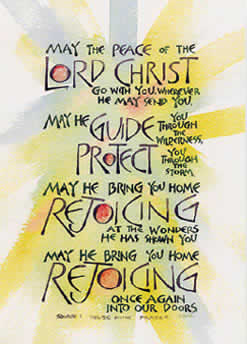
A message from the Northumbria Community

Northumbria Community is a dispersed network of people from different backgrounds, streams and edges of the Christian faith. As Companions in Community, we are united in our desire to embrace and express an ongoing exploration into a new way for living, through a new monasticism, as Christians that offers hope in our changed and changing culture. We are A Way to express The Way and acknowledge there are many other valid expressions of the desire to follow Jesus Christ in today’s world.

Do listen to the following music, which embodies the Northumbria Community way